
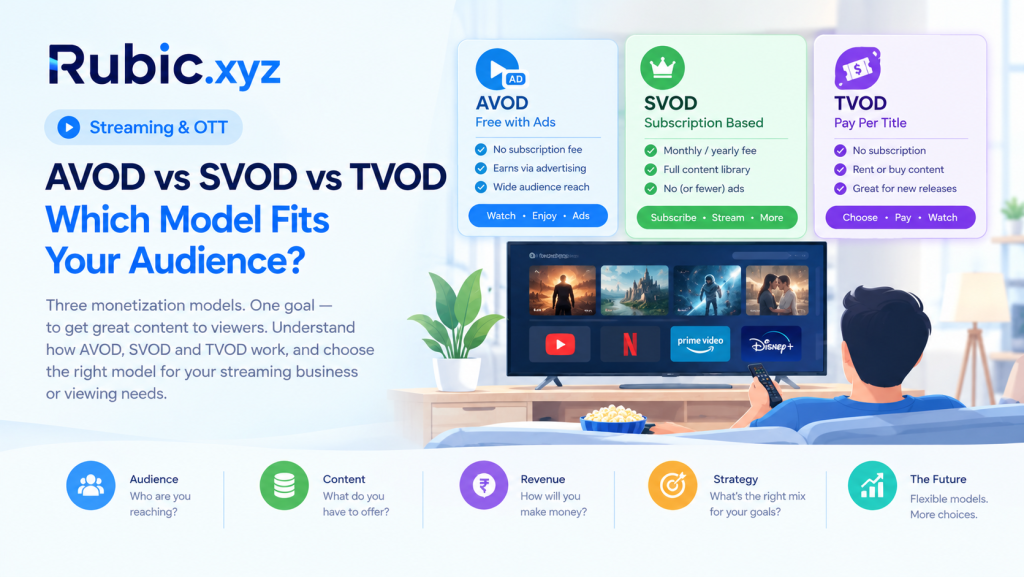
Cable TV vs Netflix type of subscriptions is what used to matter before. Not anymore. One could watch the advertisements for a couple of hours at no cost, subscribe on a month-to-month basis for a library of movies or even buy precisely what he/she needed. It can be achieved using the following three models, AVOD, SVOD and TVOD.
If you are consuming content, making it, publishing or building your video-on-demand business, then you better know your avod vs svod vs tvod. They differ in how you make money, whom you charge and how you charge them. Below is an analysis of how they operate as well as their advantages and disadvantages.
What Are AVOD, SVOD and TVOD?
The quickest way to distinguish between them is by determining what the viewer contributes – their attention, a repeated payment or just one payment?
AVOD: Advertising Based Video on Demand
No subscription fee here. The platform makes its money from ads running before, during or after whatever you’re watching. It’s the model behind most free streaming apps, ad-supported tiers and services with sprawling libraries of movies, shows, news and user-generated clips.
For viewers, the draw is simple — it’s free. The cost shows up as ads instead of dollars and how often they interrupt you depends on the service.
It also tends to bring in the crowd that wouldn’t sign up for anything paid. Drop the price to zero and you get more people watching, more often.
SVOD: Subscription Video on Demand
SVOD is built on recurring payments — monthly or yearly — for access to a catalog: movies, series, documentaries, sports, kids’ content, originals, whatever the plan covers.
Platforms like it because the income is steady and predictable. Viewers like it because it’s a setup they already know. Some SVOD services skip ads entirely, others run them anyway and some break things into pricing tiers.
It works best for people who watch a lot. Instead of paying title by title, you’re paying once for everything in the library.
TVOD: Transactional Video on Demand
TVOD is a single transaction, plain and simple — one movie, one episode, one event, no subscription attached.
So what is tvod, practically speaking? It’s rental or pay-per-view: rent a new release for a limited window or buy something outright and keep it.
It’s the right call when someone wants one specific piece of premium content and doesn’t want another monthly charge on top of everything else. For content owners, it’s a straightforward way to make money off releases people are actually excited about.
AVOD vs SVOD vs TVOD
Lined up next to each other, the gaps are easier to see.
| Feature | AVOD | SVOD | TVOD |
| Viewer payment | Usually free | Recurring fee | Per title or event |
| Main revenue source | Advertising | Subscriptions | Transactions |
| Access | Ad-supported library | Subscription catalog | Purchased or rented content |
| Best for | Broad reach | Frequent viewers | Specific premium titles |
| Main trade-off | Advertisements | Ongoing cost | Separate payments |
| Revenue pattern | Depends on audience and ad demand | More predictable | Depends on individual purchases |
This is the heart of streaming monetization models explained: none of these three works for every audience or every library. Which one fits depends on the content, how people watch it, the pricing and what the platform’s actually trying to do.
How Each Model Makes Money
Same internet, same video — very different economics underneath.
AVOD Revenue
AVOD platforms live off ad inventory, which comes down to:
- How many people watch and for how long
- Ad impressions and completion rates
- Who’s actually in the audience
- How much advertisers want in
- Targeting and placement
The hard part is finding the sweet spot — skimp on ads and you leave money behind, overdo it and people click away.
SVOD Revenue
SVOD revenue is based on continual subscription renewal. SVOD growth can be achieved by acquiring subscribers, minimizing subscriber loss, launching premium levels or entering new regions.
None of that is possible without adequate content to justify the monthly payment. The four components that go into the subscription are discovery, reliability, personalization and frequency of releases.
TVOD Revenue
TVOD earns something every time a person rents or buys — usually new releases, live events or anything people are willing to pay for on its own.
No subscription commitment for the viewer, which is a plus, but that also means the money comes in unevenly, rising and falling with whatever’s releasing and how much people want it.
Which Model Is Better for Viewers?
Depends entirely on how you watch. Don’t want to spend anything and can tolerate ads? AVOD. Watch a lot, across a lot of different content? SVOD probably pays off. Just want one film or one event? TVOD gets you there without locking you into anything.
Most people end up mixing all three — an SVOD subscription for the everyday stuff, AVOD when they just want something free, TVOD when a new release isn’t sitting anywhere else.
Choosing the Right Model for a Streaming Business
In a business, it’s not simply a matter of selecting the price tag that sounds the most impressive. Content rights, reach, acquisition prices, advertising requirements and client demands are all considered. Worth considering:
- Identify the audience. Price-sensitive? Heavy watchers? Mostly chasing specific titles?
- Review the content library. Broad catalogs lean toward subscriptions; standout individual releases often do better sold separately.
- Estimate revenue potential. Weigh subscription income against ad yield and expected purchases.
- Consider the user experience. Ad load, payment friction, discoverability and playback quality all affect whether people stay.
- Test before scaling. A smaller launch or hybrid setup shows you how people actually behave before you commit fully.
This is basically what streaming monetization models explained is about in practice — especially for platforms juggling more than one type of content under one roof.
Can AVOD, SVOD and TVOD Be Combined?
Yes and plenty of streaming businesses do exactly that rather than betting everything on one model.
A platform might run a free ad-supported tier, sell a subscription for the bigger library and sell or rent premium releases on the side. That opens up several income streams at once and gives viewers more control over how they pay.
It also lets different segments self-select — casual viewers stick with free, regulars subscribe and fans of one particular title just buy it.
The catch: don’t let combining models turn into confusing pricing. Consumers must know what is included, what costs extra and where the advertisements will appear.
Advantages and Limitations at a Glance
AVOD
Advantages
- Entry barrier is low
- Potential for broad audience reach
- No recurring payment for viewers
Limitations
- Revenue depends on advertising demand
- Too many ads can hurt the experience
- Needs real audience scale to pay off
SVOD
Advantages
- Recurring, fairly predictable revenue
- Strong fit for large content libraries
- A payment model people already get
Limitations
- Has to keep delivering value or people leave
- Churn cuts into revenue
- Content acquisition and production get expensive fast
TVOD
Advantages
- Direct revenue tied to individual titles
- Good fit for premium or newly released content
- No ongoing commitment for viewers
Limitations
- Revenue swings unpredictably
- Needs genuinely strong titles to sell
- Can add up fast for viewers buying often
Future of Video-on-Demand Monetization
The industry’s drifting toward flexibility instead of locking into one payment method. People are used to choosing between free, subscription, rental or purchase depending on what they’re after at the moment.
That’s really what avod vs svod vs tvod is about these days — not picking a winner, but understanding what each model is actually for. Free content builds reach. Subscriptions build long-term relationships. Transactions capture value from the stuff people want right now.
For businesses, the right mix probably has more to do with the audience and the catalog than whatever’s trending. A platform with varied content is usually better off giving people several ways in, as long as the pricing stays easy to follow.
Final Thoughts
AVOD, SVOD and TVOD are three different ways to turn streaming into a real business. AVOD trades attention for ad revenue, SVOD runs on recurring payments, TVOD ties revenue to individual choices.
For viewers, it’s a question of cost, how often they watch, how much advertising they’ll put up with and what they actually want to see. For businesses, it’s audience behavior, content value, rights and planning for the long run. Understanding what is tvod, avod and svod , how it’s different from a subscription and where advertising fits makes the whole decision a lot easier.
Content monetization should be rooted in the content and its target audience rather than the other way around. As the competition becomes fiercer, providing consumers with choice in the form of flexible payment plans turns out to be among the most effective ways to do so.