
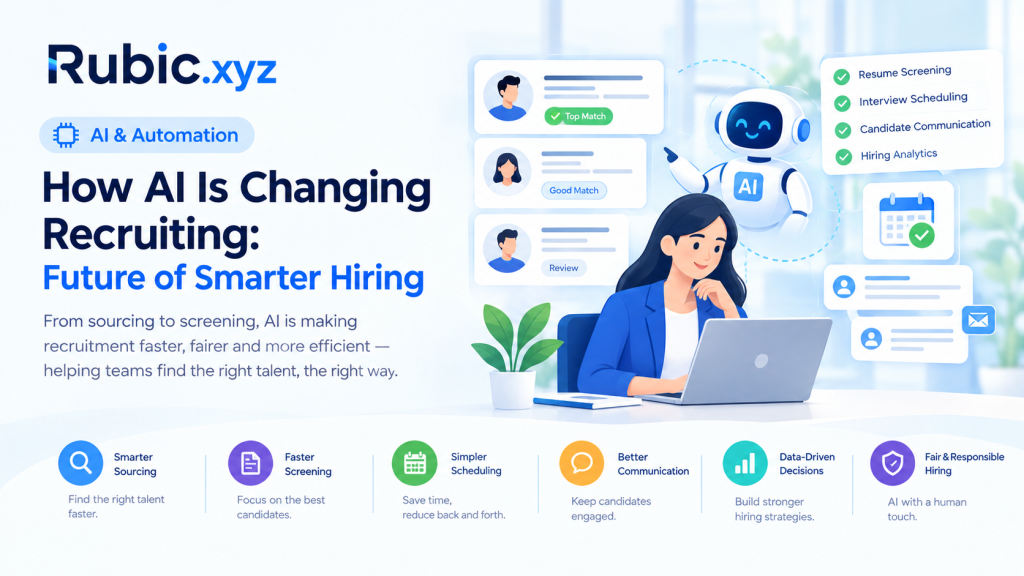
Recruitment is changing since organizations are looking for ways to recruit quickly. These tools can assist in such activities as looking for candidates, sorting out their resumes, scheduling interviews and dealing with the basic forms of communication. As more applications come in, it is not unusual for hiring teams to automate their processes in order to cope with the number of candidates.
However, this tool does much more than save time. The technology is transforming the way companies deal with the process of reviewing applications and managing hiring data. AI in recruiting explained simply involves the use of software in order to perform activities that involve lots of data or repetitive actions.
How AI Is Transforming the Recruitment Process
This technology is currently being applied for sourcing, screening, scheduling, communication and recruitment reporting. In cases where there are many applications, this technology can reduce paperwork and give recruiters time to focus on candidates.
Automation will be more successful where it handles certain responsibilities instead of the whole recruiting process.
Key Areas Where AI Is Making a Difference
Automation can help in performing many regular recruitment tasks. All of these mentioned processes have one common point; they include repetitive tasks in high volume, which is exactly when such type of software can be applied in practice.
- Candidate sourcing: Such software can analyze professional profiles and databases of recruitment agencies to find suitable skills and experience for an open position.
- Application processing: Recruitment software can store all resumes and process required data, saving time on manual selection of applications.
- Interview scheduling: Scheduling software can keep track of free time periods, make invitations and reminders without the need of additional email communication.
- Candidate communication: Automation can answer general inquiries regarding applications, job openings and interview schedule; recruiters can deal with more individual conversations.
- Recruitment analytics: Such software can reveal some trends like application dropouts and lags between hiring stages.
AI Resume Screening Explained
Another common use case of automation includes resume screening. As stated in ai resume screening explained, the computer scans the information about the application and looks for data that would be related to the requirements of the job position.
It may analyze job titles, experience, skills, qualifications and even certifications. The organization looking for developers can employ the screening software to find candidates with the relevant programming languages and development experience.
But sometimes the applicant uses another term or may have transferable skills that are not recognized by the software. Therefore, the automation of the screening process is only a preliminary step.
Why AI Resume Screening Is Becoming Popular
Manually analyzing so many resumes will require a lot of time. Such a tool can help arrange the resumes and get some relevant information for the recruiter.
But, the CV does not show the real potential of the candidate. Those who change their career or whose career is not traditional may appear as inappropriate candidates. But still, it is essential that the candidates are assessed manually.
Improving the Candidate Experience Through AI
Automation will play a significant role in making the communication process simple, like confirmation of applications, answering the most common questions, sending notifications and even conducting interviews with the applicants.
This will make the whole recruitment process easier. In other cases, some candidates may require giving reasons for their absence from work at that particular time. This is the reason why some form of face-to-face communication will be necessary.
AI Hiring Bias Concerns: Understanding the Risks
AI hiring bias concerns can emerge since the systems may mirror issues with the data they were trained on. If historical hiring practices exhibited inequalities, they can affect decisions made based on them.
For instance, an AI algorithm can attach too much weight to specific education and work experiences only because these features occurred more often within past hiring pools. Keyword bias is another type of such issue.
How Organizations Can Address AI Hiring Bias
Organizations should consistently audit the performance of their recruitment processes rather than automatically accepting the accuracy of automated recommendations.
- Evaluate systems prior to use: Conduct tests with actual use cases and measure the results against the needs of the job.
- Regularly evaluate performance: Continuously assess performance as changes may occur within the job role, candidates or data that will affect performance.
- Maintain human involvement: Recruiters must have the ability to challenge the recommendations made by tools and also consider candidates that have experience outside the norm.
- Understand how systems work: The organization needs to know what kind of data the recruitment system uses and how its findings affect the recruitment process.
Traditional Recruiting vs AI-Assisted Recruiting
Automation processes can run in parallel with interviews, references, recruitment boards and applicant tracking systems. The greatest advantage of automation processes is that they eliminate manual work in some aspects.
| Recruitment activity | Traditional approach | Automated approach | Human responsibility |
| Candidate sourcing | Manual searches | Profile and skill matching | Assess relevance |
| Resume screening | Individual review | Automated sorting | Check qualifications |
| Interview scheduling | Email coordination | Automated calendars | Handle exceptions |
| Candidate engagement | Manual responses | Automated assistance | Manage key conversations |
| Hiring analytics | Manual reports | Pattern identification | Interpret results |
| Final selection | Human assessment | Supporting information | Make the decision |
How AI Is Changing the Recruiter’s Role
With such routine jobs taken care of by automated tools, recruiters will have more time to learn about job specifications and converse with candidates and hiring managers.
Hence, recruiters must always be fully aware of the strengths and weaknesses associated with the approaches that they employ.
Skills Recruiters Need in an AI-Driven Workplace
- Data Analysis: It is essential that recruiting professionals understand how to analyze the data connected to recruitment and not just take whatever results are received blindly.
- Technological Literacy: Recruiting professionals need to have the knowledge of what capabilities their recruitment technology offers and what sort of data the outcome of the technology is limited to.
- Critical Thinking: The recommendation generated by the automation process must still be analyzed in accordance with the needs of the position.
- Communication Skills: The candidates appreciate clear communication and personal interaction in the process of recruiting.
- Ethical Awareness: Privacy, transparency and accountability remain an important factor when dealing with the information of the candidates.
Automation may influence a recruiting professional’s tasks without eliminating the need for his/her involvement.
Using AI to Make Recruitment More Data-Driven
These tools allow the recruitment team to study data on the applications and recruiting process. This might show where the candidate stops submitting their application or which source channel is responsible for producing more successful candidates.
This data could prove valuable; however, the recruiters would first have to know why this happens.
Recruitment Metrics AI Can Help Analyze
- Time to hire: This program can indicate the time taken for different steps and point out any areas that cause delay.
- Candidate sourcing: The team can contrast the origins of different applications and the journey of candidates from different sources.
- Candidate engagement: The rate of completion and responsiveness of candidates can indicate the possible drop-off points.
- Effectiveness of the recruiting process: The automation process can highlight redundancies in the process and areas where the process is delayed.
Building a Responsible AI Recruitment Strategy
Organizations must incorporate automation into the solution of a specific recruitment problem instead of implementing automation for the sake of doing so. A business strategy based on addressing the specific recruitment problem proves to be more successful than a strategy based on the use of certain technologies. When considering introducing a recruitment tool based on the technology under discussion, the following considerations should be taken into account:
- Define the objective: Determine what problem needs to be addressed by the tool.
- Check the data: Make sure the data used is relevant.
- Test the technology: Try out the tool using various applications.
- Implement human involvement: Determine where it is necessary for a recruiter to oversee the automated process.
- Ensure the protection of personal data: Apply proper methods for storing and access.
- Evaluate results: Ensure that the tool makes the process of recruiting more efficient.
Such an approach will allow for the use of automation while still involving people in decision making.
Future of AI in Recruiting
Automated software will definitely be used more and more in recruitment solutions to facilitate the handling of information about candidates. It will become integrated into sourcing, screening, scheduling, communication and analytics. As it develops, these tools are becoming more hidden and operate silently behind the scene in everyday recruiting tools.
However, ai hiring bias issues will still remain relevant. No matter how sophisticated the software is, it still requires control and review.
It seems that in the future, the question will be not whether to choose a person or software, but what to delegate to each of them. Software handles information faster, while recruiters make sense of it.
Conclusion
Automation is impacting recruiting through aiding companies to manage resumes, finding potential employees, automating communications and analyzing hiring statistics.
AI resume screening explained, is not only about the fast processing of resumes. Candidates’ careers vary and they may express their skills in different ways; thus, an automated system can overlook valuable experience.
It is perfect to use AI screening technology as a complementary tool. It can cope with routine work and sort out information while recruiters themselves are still accountable for candidates’ comprehension and decision-making. If applied appropriately and combined with regular human intervention, it can make the process of hiring both more effective and more human-oriented.