
Artificial intelligence is not restricted to answering questions and generating text anymore. What is agentic AI is becoming a frequently asked question because of the newer generation which can comprehend objectives, plan actions, operate software and perform multiple tasks with minimal human assistance. Organizations have started looking into such technology for applications like customer service, software development, research, operation and general office jobs.
The difference between these technologies can be better understood through a comparison of the currently available chatbots. Both can understand and speak the language of humans and also converse with you; but what makes the difference between the two is the reason behind their creation. While the bot will answer your query, the agent will process your request and execute it.
What Is Agentic AI?
Agentic AI is the term used to describe a system that is able to pursue a certain goal through multiple actions. Instructions are not necessarily required for each action performed, since the system will be able to break down a task into smaller tasks, choose tools, perform those tasks, evaluate the outcomes and move on to the desired result.
For example, a regular assistant could explain how to compare software subscriptions. An agent could collect information from approved websites or databases, organize the details, compare features against specific requirements and prepare the findings for review. Some common characteristics include:
- Goal-focused behavior rather than simple question answering
- Multi-step planning and task execution
- Access to approved tools, APIs, databases or software
- Context or memory maintained during a workflow
- Feedback that helps determine the next step
- Human approval for sensitive or important actions
An agent does not have to operate on its own. A company can decide what information it can access, which tools it can use and which actions require approval.
Agentic AI vs Chatbot
The primary distinction between the agentic ai vs chatbot comparison lies in the next action performed by the machine after the receipt of the instructions. The chatbot will use the dialogue and the data to create a reply. The agent will perform the same instruction as the objective and find out what should be done.
In the case of a customer asking “Where is my order?”, the chatbot will find out the status of this order and report back. The agent will investigate the order management, find out the shipment schedule, discover the delay, start the required procedures and notify the customer about that if there is such authorization.
| Feature | Traditional Chatbot | Agentic Approach |
| Main purpose | Conversation and responses | Goal completion and action |
| Workflow | Usually response-focused | Multi-step and adaptive |
| Tool use | May be limited | Often central to operation |
| Planning | Generally minimal | Can plan and sequence tasks |
| Memory | Conversation context | Context plus task state |
| Autonomy | Usually low | Adjustable within permissions |
| Human involvement | Primarily conversational | Can include approval checkpoints |
This does not mean every agent is better than every chatbot. A chatbot can handle detailed conversations, while an agent can still make errors. The real difference is how they are designed. Agents connect their reasoning to actions and tools within a particular environment.
How AI Agents Work
To understand AI agents explained in simple terms, consider a system asked to prepare a weekly sales report. It would have to do more than just answer one question. It could gather sales information, organize it, verify it and finally prepare the report.
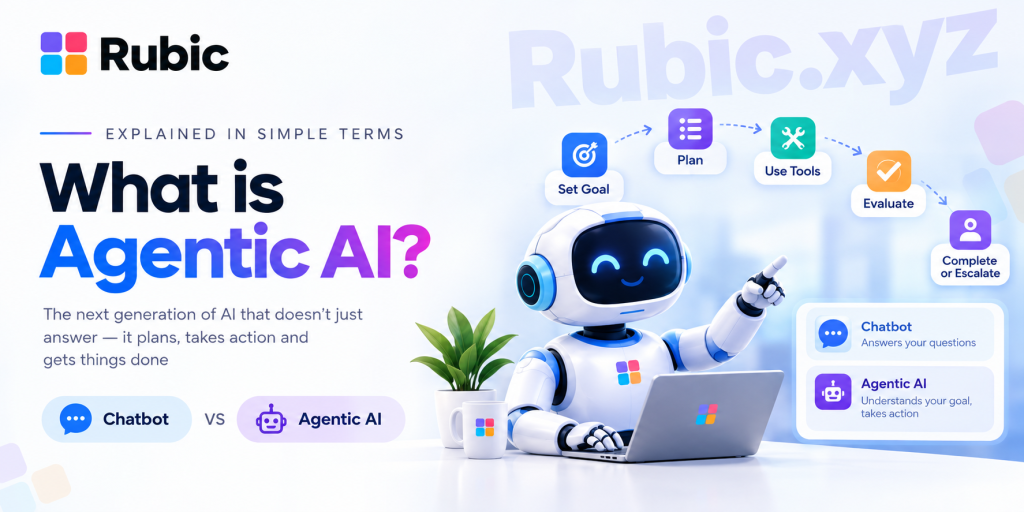
1. Understand the Goal
The system first identifies what needs to be completed, what information it needs, what limits apply and what the final result should contain. A clear objective gives it a starting point.
2. Build a Plan
The agent works out the steps needed to complete the task. For a sales report, these could include collecting sales data, cleaning the information, calculating figures, comparing them with earlier results and creating the report.
3. Use Tools and Data
An agent can use approved resources such as databases, calendars, spreadsheets, search tools, coding environments or internal business software. This gives it the ability to perform tasks instead of only writing about them.
4. Evaluate Results
After completion of the step, it becomes easy to confirm the results before moving ahead. If any information is missing or it looks like a suspicious scenario, another step needs to be done.
5. Complete or Escalate
After completing the task, the system could return the result. In case the system encounters an action that requires authorization or a human decision, it will stop and revert the task to a human being.
The step by step approach is the differentiating factor between task based systems and conversational tools.
Agentic AI Examples Across Different Industries
There are already many areas where these systems can support everyday work. Agentic AI examples include customer service, software development, research, administration and personal productivity. The amount of control given to an agent should depend on what it is being asked to do.
Customer Support
An agent can sort a customer request, find account information, check company policies, troubleshoot an issue and send the case to a support employee when necessary.
Software Development
Development agents can inspect code, find possible problems, suggest edits, run tests and summarize the results. A developer can then review the changes before they are approved or added to a live project.
Research and Analysis
An agent can collect information from approved sources, arrange the material, compare findings and prepare a research brief. A person can review the work before using it for an important business or professional decision.
Business Operations
Agents can help with scheduling, document processing, inventory checks, lead qualification, reporting and information management. If several business systems are connected, they can also reduce the amount of repetitive data entry.
Personal Productivity
With suitable permissions, an agent can organize tasks, summarize documents, prepare meeting notes or collect information from different productivity tools.
Choosing Between Agents and Chatbots for Business
It depends on what is needed from the task. In the case of a business, only answering questions or giving information for which a chatbot will be enough. An agent is useful if the task requires more actions, different software and results that cannot be generated in one reply.
Before working with an agent, it is necessary to know what an agent is capable of doing, what information can it have access to and what kind of assistance will be required from people. A practical evaluation can consider:
- How many steps does the workflow involve?
- Does the system need access to other tools?
- Can those actions be automated safely?
- What should happen when information is missing?
- Which decisions need human approval?
- How will completed actions be recorded?
These questions can help businesses choose automation based on actual needs rather than simply adopting a newer technology.
Benefits and Limitations of Agentic AI
Agent-based systems can save time through performing activities that would have involved multiple manual steps otherwise. They can move information between tools, complete routine tasks and help employees deal with larger workloads.
There are also clear limitations. An agent can misunderstand an instruction, use incorrect information, select the wrong tool or perform an action that was not intended. The concern is greater when an agent can access private business data or make changes in another system. Key measures may include:
- Least-privilege access to tooling and information
- Approval from a person for important activities
- Clear task boundaries and escalation procedures
- Activity logs for auditing
- Testing in controlled environments before deployment
- Regular monitoring and performance reviews
Giving an agent fewer permissions can also limit the damage caused by an error. For important workflows, keeping a person involved at key stages can provide another layer of control.
Future of AI Agents and Chatbots
Chatbots and agents are already starting to overlap. A chatbot can now connect with tools, retrieve information and perform certain actions. Agents, meanwhile, can use a chat interface so people can give instructions, check progress or change a task without learning a complicated system.
Future products may therefore look like ordinary chat tools on the surface while handling more work behind the scenes. A user could make one request and have the system complete several related tasks instead of responding with instructions for the user to follow.
For businesses, the useful question is what technology can improve. Faster processing, less repetitive work, better customer support and easier access to information are more meaningful measures than simply adding a new system to an existing workflow.
Conclusion
The difference between conversational systems and action-based automation mainly comes down to what happens after a request is received. One may provide an answer, while the other can work through a series of tasks to produce a result.
Both approaches have their uses in today’s software. It all comes down to the task at hand, the degree of automation necessary, the tools being used and the human involvement needed. Properly defined parameters and continuous evaluation could allow companies to leverage automation without over-endowing the system with powers beyond the task.